
Role of Enzymes in Animal Feed
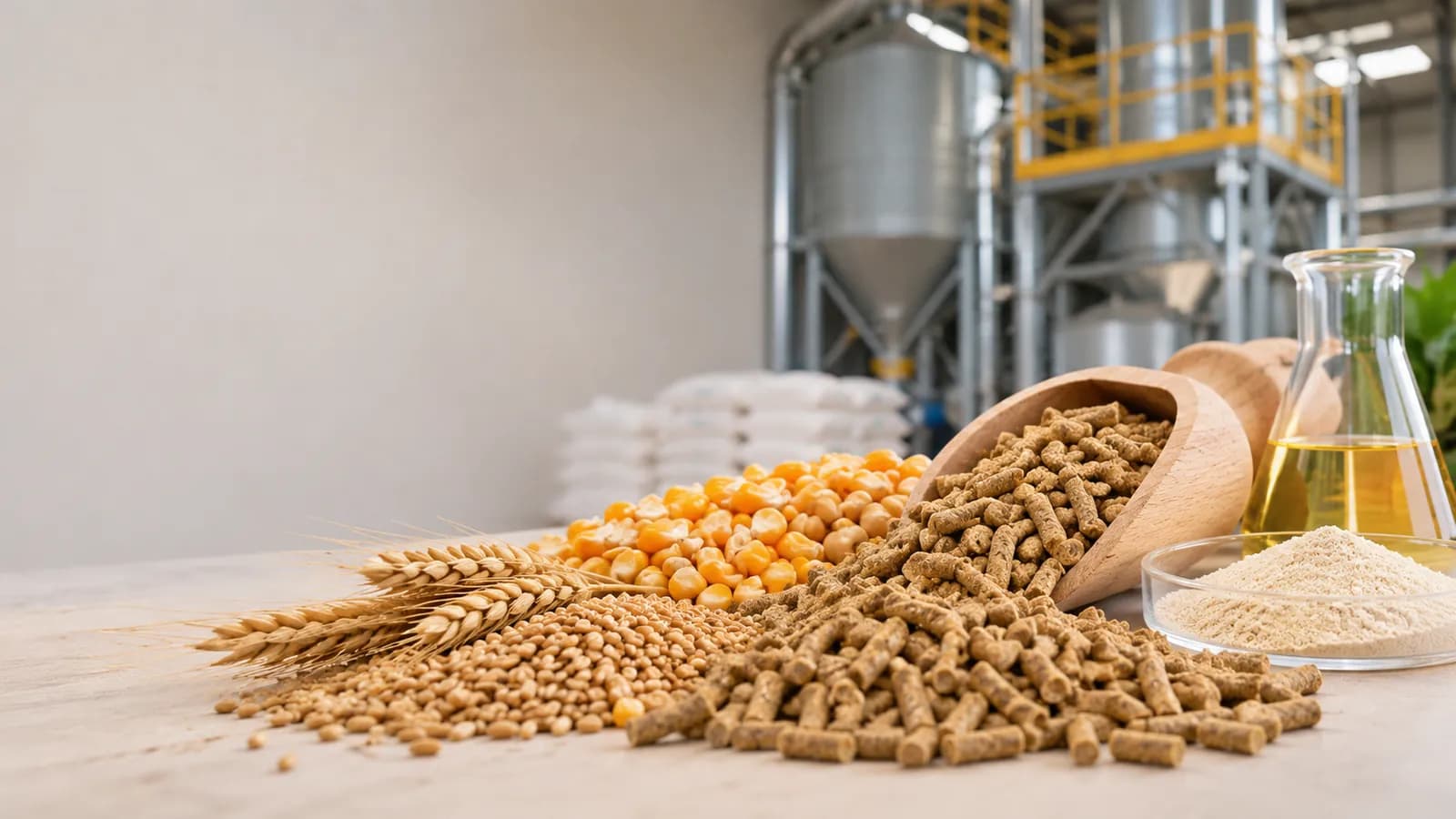
Feed ingredients contain valuable nutrients, but animals cannot always access or digest all of them efficiently. Some nutrients are held within plant structures, while others occur in forms that are less readily available to particular species. Feed enzymes can help address specific digestive limitations when they are selected and used as part of a balanced formulation.
Understanding what an enzyme acts on—and whether that target is present in the feed—is essential to evaluating its potential value.
What Are Feed Enzymes?
Enzymes are biological catalysts that speed up particular chemical reactions. Animals naturally produce digestive enzymes, but their ability to break down every component of a feed ingredient is limited. Supplemental, or exogenous, feed enzymes are added to complement this digestive capacity.
Each enzyme has a specific target, known as its substrate. Phytase acts on phytate, protease breaks down proteins, and xylanase acts on certain plant cell-wall carbohydrates. One enzyme cannot be assumed to perform the function of another.
Phytase and Phosphorus Availability
Cereal grains, oilseed meals and other plant ingredients contain phosphorus, some of which is bound in phytate. Poultry and pigs have limited ability to make full use of this phytate-bound phosphorus through their own digestive processes.
Phytase breaks down phytate and can make some of that phosphorus more available. In an appropriately formulated diet, this may allow a nutritionist to adjust the amount of supplemental inorganic phosphorus and can reduce phosphorus excretion. The adjustment must account for the enzyme’s validated activity, the diet’s phytate content, calcium and phosphorus balance, and the animal’s requirements. Adding phytase does not justify an arbitrary reduction in dietary phosphorus.
Protease and Protein Digestion
Proteases break peptide bonds in proteins, producing smaller peptides and amino acids that can be further digested or absorbed. Supplemental protease is used to support protein utilisation in suitable feed formulations.
Its response can vary with the protein source, ingredient processing, existing digestibility and enzyme characteristics. Any change to formulated protein or amino-acid levels should therefore be based on evidence relevant to the enzyme, diet and target animal—not on a general assumption that all proteases provide the same benefit.
Xylanase and Other Carbohydrases
Plant cell walls contain non-starch polysaccharides that animals digest to differing degrees. Xylanase targets xylan structures, including arabinoxylans found in ingredients such as wheat and other cereal materials. In suitable diets, its action can help release nutrients enclosed within plant structures. Where soluble arabinoxylans contribute to high intestinal viscosity, xylanase may also help reduce that effect.
Other carbohydrases have different targets. For example, beta-glucanase acts on beta-glucans, which are relevant to ingredients such as barley and oats. The choice of carbohydrase should follow the composition of the actual feed rather than the enzyme’s name alone.
Selecting an Enzyme for a Feed Formulation
A practical evaluation starts with the target species, production stage and ingredient profile. The nutritionist should then consider the enzyme’s declared activity, recommended inclusion rate, supporting evidence and compatibility with the intended formulation.
Processing matters as well. Heat, moisture and storage conditions can affect enzyme activity, so a product’s suitability for pelleted feed should be assessed against its documented stability and application instructions. If more than one enzyme is used, their combined nutritional contribution should be evaluated carefully to avoid counting the same expected benefit twice.
What Enzymes Cannot Guarantee
An enzyme cannot release a nutrient from a substrate that is absent, correct every ingredient-quality problem, or replace adequate feed hygiene and sound animal management. Results observed in one trial may not transfer directly to a different diet, species or farm environment. Performance improvements and feed-cost savings should be evaluated under relevant conditions rather than promised as fixed outcomes.
Conclusion
Feed enzymes are targeted nutritional tools. Their value comes from matching a documented enzyme activity to a specific limitation in the diet, then incorporating that activity responsibly into formulation and feed production. Careful selection and evaluation are more useful than treating enzyme inclusion as a universal solution.
Further Reading
- Carbohydrases and Phytase in Poultry and Pig Nutrition: A Review beyond the Nutrients and Energy Matrix (opens in a new tab)
- Review on Desirable Microbial Phytases as a Poultry Feed Additive (opens in a new tab)
- Dietary fibre effects and the interplay with exogenous carbohydrases in poultry nutrition (opens in a new tab)